A cenote excursion is the one Cozumel shore activity that isn't a beach or a reef. Here's what cenotes actually are, how the cavern cenotes on the island differ from mainland ones, and how to fit one into a cruise port day.
Cenote Excursion in Cozumel: What a Cavern Cenote Tour Is Really Like
Cozumel sells itself on reefs, and rightly so. But there's a moment on a cenote excursion that no reef delivers: you climb down out of thirty-degree heat and blinding sun into a limestone chamber, and the temperature drops, and the noise stops, and in front of you is water so clear that the rock shelf twenty feet below looks like it's floating in air.
That's the pitch. It's also the single most common "I didn't expect that to be the best part of the day" report we get from cruise passengers.
This guide covers what a cenote actually is, why the cavern cenotes here differ from the ones you've seen on Instagram from the mainland, what a tour involves practically, and how to fit one into a port day without cutting it close.
What a cenote actually is
A cenote is a sinkhole. That's the geology, and it undersells it considerably.
The Yucatán Peninsula, Cozumel included, is a vast slab of porous limestone — ancient compressed reef, lifted above sea level. There are almost no surface rivers here. Rainwater, mildly acidic, seeps through the rock and dissolves it from the inside, carving out an enormous network of flooded caves and underground rivers over hundreds of thousands of years. When the ceiling of one of those chambers collapses, the cave is opened to the sky.
The Maya called them dzonot. Spanish colonists rendered that as cenote.
For the Maya this was not scenery — it was the water supply, in a landscape with essentially no alternative, and it was sacred. Cenotes were understood as entrances to Xibalba, the underworld, and as passages between the world of the living and whatever lay beneath. Ritual offerings have been recovered from cenotes across the peninsula. Some of the region's largest ancient settlements were sited specifically for cenote access.
There's a further piece of the story that's genuinely difficult to absorb standing next to one: the peninsula's densest ring of cenotes traces the buried rim of the Chicxulub crater — the impact structure left by the asteroid associated with the end-Cretaceous extinction, roughly sixty-six million years ago. The fracturing from that impact shaped where the water carved. You are, in a real sense, swimming in the geological aftermath.
Open, semi-open, and cavern cenotes
Not all cenotes look alike, and the differences determine what the experience feels like.
Open cenotes are fully collapsed and exposed to the sky — essentially natural swimming pools, often with vines and roots trailing down the walls. Bright, warm, and photogenic.
Semi-open cenotes are partially roofed. A shaft of light comes through the opening and lands on the water, which produces the images most people have seen.
Cavern cenotes are the ones that stay largely enclosed. You descend into a chamber with stalactites still hanging from the ceiling and stalagmites rising from below — formations that only grow in air, which means the chamber was dry for a very long period before the water rose. Light comes from limited openings and from beneath, and the effect is more cathedral than swimming hole.
Fully submerged cave systems exist beyond these, and they are the domain of certified cave divers with specialist training. They are not a shore excursion and no reputable operator will present them as one.
For a cruise day, the cavern type is generally the most striking, because it delivers something genuinely unlike anything else on the itinerary. That's the experience behind our Jade Cavern cenote tour — an enclosed limestone chamber with formations overhead and exceptionally clear freshwater below.
Cenotes in Cozumel vs. the mainland
This is where a lot of planning goes wrong, so it's worth being direct.
The famous cenotes — the ones with the light beams and the influencer photos — are mostly on the mainland, in the Riviera Maya corridor between Playa del Carmen and Tulum. Reaching them from a Cozumel cruise ship requires a ferry crossing to Playa del Carmen, road travel, the visit itself, then the whole sequence in reverse.
On a standard port call, that math is brutal and frequently doesn't work at all. Ferries run to a schedule, they're weather-dependent, and a single delayed crossing puts your return to the ship at risk. It's not a question of whether the mainland cenotes are beautiful — they are — it's that they belong to a land-based trip, not a seven-hour port day.
Cozumel has its own cenotes, and the island is the same limestone formation with the same cave systems running beneath it. What's different is access. Many of Cozumel's cenotes sit on private or protected land, and responsible access is guided rather than freelance. They are also, correspondingly, far less crowded — you're unlikely to be sharing the chamber with four tour buses.
The tradeoff is a fair one: less iconic, dramatically more practical, and considerably more peaceful. And critically, you stay on the island, which means your return to the ship never depends on a ferry.
What a cenote excursion actually involves
Expectations, so nothing surprises you.
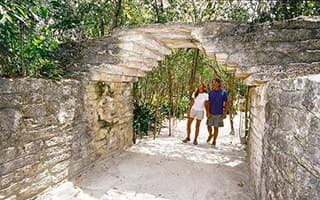
Getting there. Cenotes are inland, away from the coastal road. Access typically involves a drive and then some walking on uneven jungle terrain. Closed-toe shoes with grip are worth far more than sandals here.
Getting in. Descent is by stairs or a ladder, often steep and often damp. Nothing technical, but if mobility or steep steps are a genuine concern, ask specifically before booking rather than hoping.
The water. Fresh, not salt, and noticeably cooler than the Caribbean — typically somewhere in the low-to-mid seventies Fahrenheit year-round. The first thirty seconds are a shock; after that most people stop noticing. Clarity is extraordinary because there's no plankton and no surf stirring sediment. Life forms are sparse compared with a reef — small fish, sometimes freshwater shrimp — so if you're expecting reef biodiversity, that's the wrong measure. The spectacle is the geology and the light.
Safety and gear. Life jackets are standard and usually required regardless of swimming ability, since depths vary sharply and the walls offer little to hold. Guides stay in the water with the group. Our safety standards and guide certification page covers what we require, and you can read about the guides who run these trips directly.
The rules, which are not optional. Shower before entering where facilities exist. No sunscreen, no bug spray, no lotions of any kind in the water — cenotes are closed freshwater systems with minimal circulation, and chemical residue accumulates rather than dispersing. Touch no formations; stalactites take millennia to grow and skin oils halt them permanently. Take nothing out.
How long. A cenote stop typically runs one to two hours including entry, swim, and photos — which makes it very combinable with a second activity rather than a whole-day commitment.
Fitting it into a cruise port day
Cozumel port calls generally give you seven to nine hours, with all-aboard usually thirty to sixty minutes before sailing. Plan backwards from all-aboard.
A cenote pairs well as a morning anchor. Inland heat builds through the day, the underground chamber is coolest and quietest early, and finishing by early afternoon leaves the beach or reef block open. It also pairs naturally with a Maya cultural stop, since the two are connected historically and often geographically — cenotes were why settlements existed where they did.
The pairing to avoid is cenote plus a full-day water excursion. Both involve changing, drying off, and transit; stacked together they produce a day spent mostly in a van. Two anchors and a meal is the realistic ceiling.
Your pier matters for timing too. Puerta Maya and the International Pier sit south of town, while Punta Langosta is downtown — a difference of a few minutes that still needs to exist in your plan. Our Cozumel cruise port overview covers all three, and the plan your day tool builds an itinerary against your ship's actual times.
If you're weighing a cenote against the island's other options, our tour comparison page puts them side by side, and things to do in Cozumel covers the broader field.
What to bring
Short list, and it's short deliberately:
- Swimsuit worn under your clothes. Changing facilities at cenotes range from basic to nonexistent.
- Closed-toe shoes with grip. Wet limestone is genuinely slick. This is the item people most often get wrong.
- A quick-dry towel.
- A dry bag for phone and wallet.
- Small pesos for tips and incidentals.
- A waterproof camera or housing if you care about photos — the underwater clarity is the shot.
- No sunscreen before the cenote. Apply after, if the day continues to a beach.
Our what to bring to Cozumel packing list covers the wider port day, and first-time visitor guidance is worth five minutes if this is your first Mexican port.
Is a cenote excursion worth it?
If you've snorkelled before, if you've had beach days on other islands, if you want the one thing from this trip that doesn't resemble the rest of it — yes, comfortably.
If you're travelling with someone who won't manage steep wet stairs, or if the group's priority is genuinely sun and a lounger, a reef or beach day will make more people happier. That's a legitimate answer and worth being honest about in advance.
For most people the calculus is simple: reefs are the reason Cozumel is famous, and you should see one. But the cenote is the part they describe afterwards — the silence, the cold, the water so clear it barely registers as water, and the strange awareness that people were coming to this exact chamber for reasons far older than tourism.
When you're ready, our Jade Cavern cenote excursion includes pier pickup, guided access, gear, and a return guaranteed before all-aboard. You can browse the full tour catalog to pair it with an afternoon activity, check the frequently asked questions for anything unresolved, or reserve online against your ship's schedule.
Seven hours goes quickly. Spend an hour of it underground.