El Cielo is a standing-depth sandbar, not a swim — but most El Cielo tours also include deep-water reef stops. Knowing which stop is which is the difference between opting out of the trip entirely and enjoying nearly all of it.
El Cielo Cozumel for Non-Swimmers, Nervous Swimmers, and Limited Mobility
There is one question about El Cielo Cozumel that the guides tend to skip, and it is the question that decides whether a lot of people go at all:
Can I do this if I'm not a confident swimmer?
Usually the person asking has already half-answered it themselves. They have seen the photographs, read that it is a snorkeling trip, concluded it is not for them, and started looking at beach clubs instead. Sometimes it is a grandparent bowing out so the rest of the family can go. Sometimes it is one adult in a group of six quietly deciding to stay on the ship.
In a large share of those cases, the decision is based on a misunderstanding of what the trip physically involves.
Here is the thing worth knowing before you rule it out: El Cielo itself is one of the few places in Cozumel where you can stand up. The difficulty is that "an El Cielo tour" usually is not just El Cielo.
The distinction that changes the answer
Nearly every El Cielo tour sold in Cozumel is a multi-stop boat trip, and the stops have completely different physical demands. Typically:
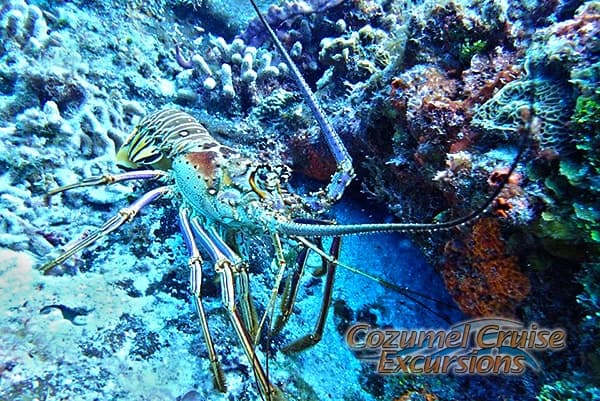
The reef stops — commonly Palancar, Colombia, or a nearby reef — are deep water. You are floating over coral with no bottom within reach. This is real snorkeling, and it is where a weak swimmer feels out of their depth in the literal sense.
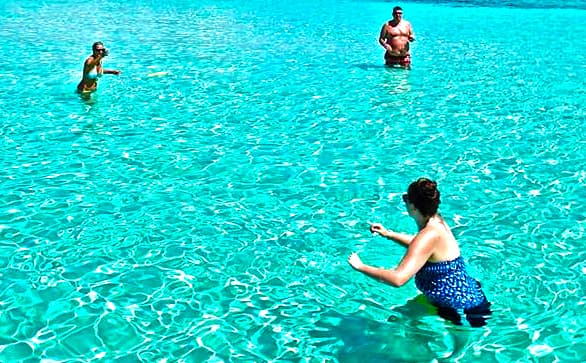
El Cielo itself is a shallow sandbar over white sand. Depth varies with tide and exactly where the boat anchors, but it is broadly standing depth — commonly around waist to chest height on an adult. This is where the starfish are, where the water goes that luminous pale turquoise, and where essentially every photograph you have seen of El Cielo was taken.
So when someone says "I can't snorkel, so I can't do El Cielo," they are usually declining the sandbar because of the reef. Those are different stops, often an hour apart.
You can do the sandbar and sit out the reef. On most tours, that is a completely normal thing to do, and no operator worth booking will make it awkward. You stay on the boat during the deep stop, or you get in wearing a flotation vest and hold the line, and then you fully participate at El Cielo.
If you want the general orientation on the destination itself — where it is, why the water looks like that, what the regulations are — our complete El Cielo Cozumel guide covers it. This article is specifically about whether your body can do the trip.
What "standing depth" does and does not mean
Some honesty is required here, because "you can stand up" gets oversold.
It is a sandbar in open water, not a swimming pool. There is current. There is boat traffic in the area. The bottom is uneven, and the depth is not uniform — take a few steps and it can go from thigh-deep to chest-deep.
Wind and tide change it. On a calm day it is close to idyllic. On a windy day there is chop, and chop at chest height is more tiring than people expect.
You still get in from a boat. This is the part that matters most for mobility, and it is covered below.
Flotation is normal, not remedial. Snorkel vests and life jackets are standard equipment on Cozumel boats and are routinely worn by competent swimmers. Nobody is looking. Wearing one at the sandbar means you can relax completely rather than managing your balance the whole time.
The practical summary: El Cielo is realistic for a non-swimmer in a flotation vest, staying near the boat or a guide, on a reasonable weather day. It is not a place to test whether you have got over a genuine fear of water on your own.
Getting in and out of the boat
This is the real accessibility question, and it has nothing to do with swimming.
Access to El Cielo is by boat only — there is no shore access, no walking to it, no road. That means every visitor negotiates the same sequence: boarding at the pier or marina, and then entering and exiting the water from the vessel, usually via a ladder at the stern.
Things that genuinely affect this:
The ladder. Coming out of the water is harder than going in, particularly with fins on and in any swell. If you have limited upper-body strength, shoulder problems, or a knee that objects to ladder rungs, this is the step to ask about.
The dock transfer. Boarding at the marina may involve a step down onto a moving deck, sometimes with a gap. Crew assistance is typical, but it is worth confirming.
Boat type. Larger catamarans generally have wider, more stable platforms and gentler ladders. Smaller, faster boats get you there quicker but ride harder — which matters for anyone with back problems or motion sensitivity.
Time in the sun with limited seating. Shade varies enormously between vessels. For anyone with heat sensitivity, ask directly how much shaded seating there is.
None of these are necessarily disqualifying. All of them are things a good operator can plan around if you tell them in advance, and cannot do much about if you mention it as you are stepping onto the boat. Our safety standards and equipment page sets out what is carried as standard, and it is worth raising specific needs at the time of booking rather than on the day.
Who should think carefully
A few situations warrant a more considered conversation than a booking form allows:
Recent surgery, or a healing wound. Salt water and boat ladders are not the issue so much as the exertion and the exposure. Check with your own clinician.
Significant heart or respiratory conditions. Snorkeling is mild exercise, but it is exercise, in heat, away from immediate medical care.
Severe motion sickness. The crossing to the southwest side of the island takes a while, and the boat sits at anchor at each stop. Anchored bobbing is worse than moving for many people. Take preventative medication before boarding rather than after symptoms start.
Pregnancy. Many operators have policies here, particularly in later trimesters, and boat boarding in swell is the concern rather than the snorkeling.
Genuine, acute fear of open water. A shallow sandbar is a kind way to meet the ocean. It is still the ocean. Being talked into a boat by relatives rarely ends well.
If any of this applies, ask before booking — not because the answer is likely to be no, but because the operator can usually accommodate you if they know.
For families splitting across abilities
This is the most common real-world version of the problem: a group where one or two people cannot or do not want to do the deep-water portion.
The workable pattern is straightforward. Book the multi-stop tour anyway. Confident swimmers do the reef stops. Everyone else stays aboard, and then the whole group is together at El Cielo, which is the part people remember regardless of swimming ability.
Two things make this go smoothly:
Say it at booking. "Two of our six will stay on the boat for the reef stops" takes ten seconds and lets the crew plan.
Consider a private charter for mixed groups. On a shared boat, the itinerary is fixed. On a private one, you can spend longer at the sandbar and cut the deep stops short. For a family with a wide spread of ages and abilities, this often solves the problem outright.
Our Cozumel with kids guide covers the family angle in more detail, and the snorkeling tour options show which trips include which stops so you can match the itinerary to your group before you book.
The starfish rule applies to everyone
One thing that is not negotiable regardless of ability: do not pick up the starfish.
El Cielo sits within Cozumel's protected marine park, and lifting starfish out of the water is prohibited. It is not a formality — removing them from water is genuinely harmful to the animals, and the sandbar's population has suffered from decades of visitors posing with them for photographs.
Look, photograph them underwater, and leave them where they are. Reef-safe sunscreen — or better, a rash guard instead of sunscreen — is likewise expected in the park.
Practical questions to ask before booking
For anyone with swimming or mobility concerns, these six questions will tell you almost everything:
- How many stops, and which are deep water versus standing depth?
- How long is the stop at the sandbar specifically?
- Are flotation vests available, and can I wear one the entire time?
- What does getting in and out of the water involve — ladder height, crew assistance?
- Can I stay on the boat during the reef stops?
- How long is the boat ride, and is there shade?
Any operator who answers those clearly is one you can trust with the day. Vagueness on question four in particular is worth noticing.
Our Cozumel FAQ answers many of these in general terms, and the El Cielo snorkeling tour page lists the specific stops and timings for that trip.
The bottom line
El Cielo is one of the few genuinely famous Cozumel experiences that does not require you to be a strong swimmer. The confusion comes from it being bundled with reef stops that do.
Separate the two in your head, wear the vest, ask about the ladder, and tell the operator what you need before the day rather than on it. Most people who rule themselves out of El Cielo did not need to.
Planning the rest of your port day around it? Our Cozumel day itinerary planner helps fit the boat trip around your ship's schedule.
Note: Water depth at El Cielo varies with tide, weather, and anchoring position, and conditions change day to day. Nothing here is a guarantee of conditions on your visit. If you have a medical condition, discuss boat travel and snorkeling with your own physician first, and always follow the instructions of your captain and guides.