
Snorkeling Cozumel is easier and far more fun once your mask seals, your breathing slows and your fins do the work, so here is the technique guides teach.
Most people who come back from snorkeling Cozumel disappointed were not let down by the reef. They were let down by a leaking mask, a mouthful of salt water at the wrong moment, or legs that were exhausted ten minutes in. The good news is that all three are technique, and technique can be learned in the time it takes a boat to reach the first reef. This is the lesson our guides give on the bow every morning, written down so you can read it the night before on the ship, and it applies whether you are booking with Cozumel cruise tours or anyone else.
How do you get a snorkel mask to seal and stay clear?
Fit comes before everything. Hold the mask against your face without the strap, breathe in gently through your nose, and let go; a mask that fits will stay on by suction alone for a second or two. If it drops, try another. Every boat carries several sizes and shapes, and the guide would far rather swap your mask at the dock than hear you spit water at the reef.
The two things that break a seal are hair and sunscreen. Push every strand of hair off your forehead and temples before the mask goes on, and keep lotion away from the area the skirt touches; a greasy skirt slides, and sunscreen in your eyes stings for the rest of the swim. A mustache can leak too, and a thin smear of lip balm along the top of it usually solves it.
Then the strap, which beginners crank far too tight. The strap only holds the mask in place; the seal comes from the skirt and a slight vacuum. Tighten it just enough that the mask sits level and does not slide when you look down. An over-tight strap causes more leaks than a loose one, because it distorts the skirt and leaves you with a sore face by lunch.
Fog is the last mask problem, and the fix is simple. Before the mask touches water, rub a drop of the defog solution the crew hands out, or baby shampoo, or plain spit, across the inside of the lens, then rinse once. Do it at the dock and again at the second stop if needed. If water does get in, lift the lower edge of the mask slightly while looking up and exhale through your nose; the air pushes the water out the bottom without taking the mask off.
How should you breathe through a snorkel?
A snorkel asks you to do one unnatural thing: breathe through your mouth with your face in the water. The instinct is to breathe fast and shallow, which fogs the mask, tires you out and makes you feel short of air. Instead, take slow, deep breaths with a slight pause at the top, and listen to them; if you can hear yourself breathing steadily, you are doing it right.
Keep the snorkel roughly vertical by keeping your face angled slightly down and forward rather than straight ahead. If you look up at the boat with your face in the water, the tip dips and you get a mouthful. Many snorkels have a splash guard or dry valve at the top, which helps in a chop but is not magic; a wave will still get through now and then.
When water does come in, do not lift your head and tear the mask off. Keep your face down, take one strong exhale through the snorkel, like blowing out a candle across the room, and the water clears. Then breathe in cautiously, because a little may remain. Practice this clearing blast in the ship's pool the day before, three or four times, until it stops feeling like an emergency.
Breathing is also where panic starts and where it stops. If you ever feel your chest tightening, roll onto your back, let the vest float you, take the snorkel out and breathe sky air until it passes. Nobody on the boat will think less of you, and your guide has done the same thing with hundreds of guests.
Do you need fins, and how do you use them in Cozumel's current?
Yes, you need fins, and in Cozumel more than most places. Much of the island's best snorkeling is drift snorkeling along the western reefs: the boat drops you at one end, the current carries you along the coral, and the boat picks you up at the other. Fins are what let you hold position to look at something, swing back to the group and steer around a coral head without flailing.
Good finning starts at the hips, not the knees. Keep your legs long and almost straight, with a slight bend at the knee, and kick slowly from the hip in long strokes, as if you were walking in slow motion. A fast bicycle kick churns the surface, splashes everyone behind you and uses far more energy for less speed. Keep your arms still along your sides or folded in front; they are for steering, not propulsion.
Stay horizontal. The flatter you float, the less drag you have, the less you kick, and the less likely you are to sweep a fin across the coral below. Never stand on, kick or hold the reef, even to rest; the marine park rules exist because a fin edge can undo decades of coral growth in a second, and standing on fire coral hurts for days. If you need to rest, float on your back or signal the boat.
Put fins on at the ladder, not on deck. Walking in fins is how ankles get turned, so sit on the last step, slip them on, and enter feet first. Coming back, take them off at the ladder and hand them up before you climb. Your guide will show you the exact spot.
Where is snorkeling Cozumel easiest for a beginner?
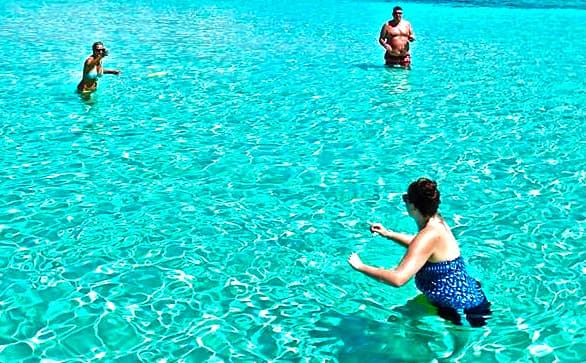
Technique matters less on some sites than others, and a smart first-timer picks the site to match. The sandbar at el cielo is the obvious starting point: waist-deep, calm, sandy-bottomed, with starfish and rays visible from standing height. You can practice mask clearing with your feet on the sand and your face in warm, clear water, which is the perfect classroom.
The reef sites of the marine park, Palancar, Colombia and their neighbors, are deeper and have current, which is exactly why they are spectacular. They are also where fins, breathing and buoyancy earn their keep. Most boat tours combine a reef drift with a stop at the sandbar, so you get both, usually the reef first while the group is fresh and the sandbar second to relax.
Tell the guide if you are new, nervous or a weak swimmer. A good guide puts you beside them in the water, hands you a flotation ring if the group is spread out, and keeps the drift short. Nobody is marked down for taking a vest, and many of our strongest swimmers wear one anyway because it lets them float and look without kicking at all.
How does the day run from the cozumel cruise port to the boat?
Your pier shapes the morning. If your ship ties up at Puerta Maya, the cozumel cruise port south of town, the meeting point is a short walk out of the terminal and the transfer to the marina is quick; from Punta Langosta downtown the ride is a little longer in the other direction. Either way, your guide meets you with a sign, checks the group against the ship's all-aboard time and gets you moving.
At the boat, the sequence is gear, briefing, practice. You are sized for a mask and fins while the captain runs out, the guide covers the hand signals (okay, help, look here, back to the boat) and the entry and exit routine, and the first stop includes a few minutes to get your mask and breathing right before anyone goes anywhere near coral. If something does not feel right in those first minutes, say so; swapping a mask at the first stop takes thirty seconds.
Between stops, drink water, not beer. Alcohol dehydrates, dulls judgment and makes seasickness worse, and the cold drink tastes far better on the ride home. Reapply reef-safe sunscreen on your back and the backs of your legs, which spend the whole swim facing the sun, but keep it off your face until the last swim is done.
Which mistakes undo good technique?
Over the years our guides have watched the same handful of errors turn a good swimmer into an unhappy one:
- Hyperventilating before putting your face in, which makes you light-headed and anxious before you have seen a single fish.
- Chasing fish, which puts you out of the group and into deeper water in a hurry, and never catches the fish.
- Diving down to touch something, which sends a fin into coral and salt water into the snorkel at the same moment.
- Skipping the vest out of pride, then spending the swim treading water instead of looking down.
- Sunscreen on the face right before the mask goes on, which is the single most common cause of a leaking mask and stinging eyes.
The remedy for all of them is the same: slow down. Snorkeling rewards the person who floats still, breathes slowly and lets the reef come to them. The turtle you wanted to see is far more likely to swim past a quiet, horizontal floater than a splashing swimmer trying to catch up with it.
Get the mask, the breathing and the fins right and snorkeling Cozumel becomes what it should be: an hour of weightless drifting over some of the clearest water in the Caribbean, with your guide pointing out the things you would never have spotted alone. When you are ready to put the technique to work, browse tours to compare the sandbar trips, reef drifts and combinations that fit your ship's hours, and tell us it is your first time so we can put you with the right guide.