An all-inclusive cultural experience cruise day is possible in Cozumel — but only if you plan around the ship's clock, the island's geography, and what \"all-inclusive\" actually covers. Here's how to build the day properly.
The All-Inclusive Cultural Experience Cruise Day: How to Actually Do Cozumel Right
There's a specific kind of disappointment that happens on cruise port days. You had seven hours in Mexico. You spent ninety minutes of it in a duty-free jewelry corridor, ate at a chain restaurant with a menu in four languages, bought a keychain, and got back on the ship wondering what exactly you'd just seen.
Meanwhile the couple two cabins down swam in a limestone cavern, ate cochinita pibil at a family kitchen, walked through a thousand-year-old Maya site, and were back aboard with time to shower before dinner.
The difference between those two days is almost never money. It's planning — specifically, understanding what an all-inclusive cultural experience cruise day requires in a port where geography, the ship's clock, and the pier you happen to dock at all quietly conspire against improvisation.
Here's how to build the good version.
What "all-inclusive" actually means in a port context
The phrase gets used loosely enough to be nearly meaningless, so it's worth pinning down. On a Cozumel shore day, "all-inclusive" usually refers to one of three quite different things.
All-inclusive beach club or resort day pass. You pay once and get access to the property, loungers, pool, food, and domestic drinks for the day. This is the most literal use of the term. The value depends heavily on whether you'll genuinely eat and drink enough to clear the threshold — and whether spending your only day in Mexico at a pool is the memory you want. Our resort and beach club day passes page lays out what each property includes.
All-inclusive excursion. Transport, guide, entrance fees, equipment, food, and drinks bundled into one price with nothing to pay on the ground. This is the version that matters for a cultural day, because it eliminates the friction — the taxi negotiation, the separate site fee, the hunt for lunch, the currency question — that eats port hours.
"All-inclusive" as marketing. Some listings use the phrase and then exclude entrance fees, gratuities, gear rental, or transport. Always read what's specifically named. Any operator that won't itemize inclusions in writing is telling you something.
For a cultural day, the second definition is the one to insist on, and it's the model our full excursion catalog is built around — the price you see is the price the day costs.
The three piers, and why it matters more than you'd think
Cozumel has three cruise piers, and which one you're assigned to changes your day meaningfully.
Puerta Maya and the International Pier sit south of downtown San Miguel, a few minutes apart. Punta Langosta is right in town, walkable to the central plaza and the ferry terminal.
If you're at Punta Langosta, you can be standing in the main square within ten minutes on foot. From the southern piers, town is a short taxi ride. Neither is a problem — but a plan that assumes you'll "just walk into town" from Puerta Maya has already lost half an hour it didn't budget.
Your pier assignment can also change close to sail date. The practical answer is to book excursions that meet you at your actual pier rather than a fixed downtown address. Our Cozumel cruise port guide breaks down each terminal, and the cruise schedule shows which ships are in on a given day — worth checking, because a four-ship day and a one-ship day are different islands.
The cultural anchors worth building a day around
Cozumel's cultural depth surprises people who arrive expecting only reefs and tequila shops.
San Gervasio
The island's principal Maya archaeological site, set inland in the jungle. San Gervasio was a sanctuary associated with Ix Chel — goddess of the moon, fertility, medicine, and weaving — and it was a genuine pilgrimage destination. Maya women were expected to travel here at least once in their lives, crossing from the mainland by canoe.
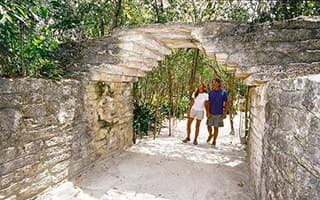
That context matters, because San Gervasio is not Chichén Itzá and shouldn't be judged against it. There is no towering pyramid. What there is instead is a network of low structures, arches, and sacbeob — raised white limestone roads — threaded through dense forest, with iguanas everywhere and often very few people. It's atmospheric rather than monumental, and with a guide who can explain what you're looking at, it's the most substantive hour of history available on the island. Without one, it's a pleasant walk past some rocks. Our guide to Cozumel's Mayan ruins covers the site in more depth.
El Cedral
The oldest Maya settlement on Cozumel and still a living village rather than a preserved ruin. There's a small Maya structure, a modest church, and an actual community around it. It's a short stop, but it gives the day a texture that a purely archaeological itinerary doesn't.
Punta Sur and the island's south
The ecological park at the island's southern tip holds a lagoon with resident crocodiles, a lighthouse with a long climb and a genuinely excellent view, and a small Maya navigational structure. It's a nature-and-culture combination that fills a couple of hours comfortably.
The food, treated seriously
This is the piece people skip, and it's the one they remember. Yucatecan cooking is regionally distinct from what most visitors think of as Mexican food — cochinita pibil slow-cooked with achiote and sour orange, sopa de lima, panuchos, salbutes, and habanero used with far more precision than its reputation suggests. Cozumel adds fresh seafood and its own ceviche traditions.
A cultural day that includes a real meal at a family-run kitchen rather than a tourist-corridor restaurant is a different day. This is exactly where the all-inclusive structure earns its keep, because "we'll find somewhere good" tends to collapse into "we found somewhere close" once the clock is running.
Building the day: a realistic template
Most Cozumel port calls give you roughly seven to nine hours, and all-aboard is typically thirty to sixty minutes before departure. Work backwards from all-aboard, not forwards from arrival — this single habit prevents most port-day stress.
A well-constructed all-inclusive cultural day usually looks something like this:
Morning — the inland cultural block. Head to San Gervasio early, before the heat peaks and before the multi-ship crowds arrive. Guided, so the site actually means something. Add El Cedral if the itinerary allows.
Midday — the meal. A proper Yucatecan lunch, ideally somewhere that would exist whether or not cruise ships did.
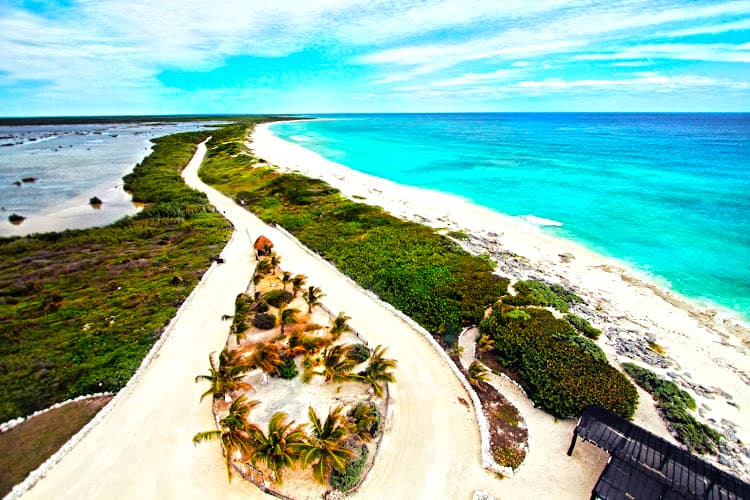
Early afternoon — water or coast. The island's defining feature is the reef system, and a cultural day doesn't have to exclude it. A short snorkel stop, a beach interval, or the drive down the wild eastern shore — where the open Caribbean hits the coast and there's almost no development — all work. If you'd rather stay on the water for this block, the catamaran snorkel sail and the shallow, luminous El Cielo sandbar are both easy to slot in.
Late afternoon — town, deliberately. The central plaza, the artisan market, a coffee. Not the pier shopping corridor. Ninety minutes here is worth more than four hours of it.
Buffer. Build in an hour of slack. Always.
If you want to run the numbers on your specific ship times, our port day planning guide walks through the timing math, and what to do in Cozumel covers the wider set of options if you'd rather assemble your own.
The mistakes that ruin otherwise good days
Trying to reach the mainland ruins. Tulum and Chichén Itzá require a ferry to Playa del Carmen plus substantial road time each way. On a standard port call it is either impossible or reduces the actual site visit to a frantic march. Cozumel's own sites are the sane choice; save the mainland for a land-based trip.
Booking with no return guarantee. Independent operators are frequently better and better value than ship-sold tours, but only if they contractually guarantee your return before all-aboard. That guarantee is the entire risk difference, and it's why we publish our return-to-ship guarantee and operating standards rather than leaving it implied.
Stacking too much. Three major activities in seven hours produces a day spent in transit. Two anchors plus a meal is the ceiling for a day that feels like an experience rather than a logistics exercise.
Assuming cash won't be needed. Even on an all-inclusive excursion, small pesos for tips and market purchases smooth everything. USD is widely accepted; small bills fare better.
Skipping the guide. For archaeological sites specifically, a guide is the difference between context and rubble. This is the single highest-return line item in a cultural day.
Underestimating sun and water. Midday inland heat and humidity are real. Reef-safe sunscreen is required at the marine parks, and it's the right call everywhere on the island regardless.
Why the all-inclusive structure suits a cultural day specifically
Beach days tolerate improvisation. Cultural days don't.
A cultural itinerary has fixed sites with entrance fees and operating hours, meaningful distances between stops, a guide who has to be arranged in advance, and a meal that has to happen somewhere specific. Every one of those is a point where an unbundled day leaks time — negotiating a taxi, queuing for tickets, discovering the site closes earlier than expected, deciding where to eat.
Bundling those decisions removes the friction and converts the day from a series of small logistical problems into an actual experience. That's the entire argument for the all-inclusive model here, and it's why we structure our Cozumel shore excursions around fixed pricing, pier pickup, and a guaranteed return rather than à la carte add-ons.
If you want to see how previous cruise passengers have found it, our guest reviews are unfiltered, and when you're ready to lock a date, reserving your excursion online takes a few minutes and confirms against your ship's actual schedule.
Seven hours is not long. It's long enough to see something real — but only if you decide in advance that you're going to.