An all-inclusive cultural experience cruise day is only as good as what you understand while you're standing there. Here is the history behind San Gervasio, El Cedral, the island museum and El Caracol — the context that turns a photo stop into a visit.
What You're Actually Looking At: A Heritage Field Guide to Cozumel's Cultural Sites
There is a particular kind of disappointment that happens on cultural excursions. You arrive at an archaeological site, walk among modest stone structures for forty minutes, take photographs, and leave with the vague sense that you were supposed to feel something you did not feel.
This almost never happens because the site is unremarkable. It happens because nobody told you what you were looking at.
Cozumel's cultural sites are not visually overwhelming in the way Chichén Itzá is. There is no towering pyramid dominating the horizon. What Cozumel has instead is significance — it was one of the most important pilgrimage destinations in the Maya world, and it was one of the first places in the Americas where Europeans and Maya society made sustained contact. Those facts are not visible in the stones. They have to be supplied.
So this is not another guide to planning a cultural port day. If you want the logistics, our overview of Cozumel cultural tours and how to structure them and our port day planning guide handle that thoroughly.
This is the background reading. It is what makes the difference between seeing San Gervasio and understanding it.
First, the island's name and its role
The Maya called this island Cuzamil, commonly rendered as "island of swallows." It sat off the eastern coast of the Yucatán Peninsula, close enough to reach by canoe and far enough to feel separate — which is precisely the geography that makes a place sacred.
Cozumel's importance came from Ix Chel, a goddess associated with the moon, fertility, childbirth, medicine and weaving. The island held a major shrine to her, and it drew pilgrims from across the Maya world. The tradition most often described is that Maya women were expected to make the journey at least once in their lives, particularly around matters of fertility and childbirth.
Sit with the logistics of that for a moment. This meant crossing open water in a canoe, from the mainland, in an era without engines — undertaken as a religious obligation, repeatedly, by ordinary people, for centuries. The island functioned as a destination in a network of pilgrimage routes and sea trade running along the Yucatán coast.
That is the frame to carry with you. You are not visiting a settlement that happened to be on an island. You are visiting a destination that people crossed the sea to reach.
San Gervasio: the pilgrimage site
San Gervasio is the island's principal archaeological site, sitting inland from the coast amid low forest. It is the physical centre of the Ix Chel pilgrimage tradition, and the most substantial Maya site you can reach on a port day without leaving the island.
What to notice while you are there:
The site is dispersed, not concentrated. Structures are spread across cleared areas linked by paths through the forest. This layout is itself meaningful — this was a place people moved through, along processional routes, rather than a single monument to stand in front of.
Look for the sacbé. Sacbeob (singular sacbé) are raised limestone causeways, literally "white roads," that connected Maya sites. San Gervasio's remnants are a reminder that this was infrastructure, deliberately built to carry people to a destination.
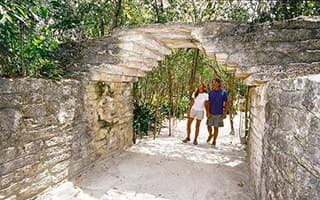
The arch. One of the site's recognisable features is an arched structure often interpreted as a gateway — a threshold marking entry into the ceremonial area. Thresholds matter enormously in pilgrimage: the moment of crossing from ordinary space into sacred space is the point of the journey.
The scale is domestic, and that is the point. These are not imperial monuments built to intimidate. This was a working religious centre serving pilgrims, closer in spirit to a shrine complex than to a capital.
The forest itself. The vegetation is dense, hot and full of birds and iguanas. This is roughly the environment pilgrims moved through. The heat is part of the historical experience, whether or not you want it to be.
A practical note: San Gervasio is a protected archaeological site, and site entry fees are typically administered separately from any tour price. Confirm with your operator what is and is not included so there are no surprises at the gate. Our Cozumel Mayan ruins guide covers the visiting details.
El Cedral: the oldest settlement, and the layered one
El Cedral is small. Visitors sometimes wonder why it is on the itinerary at all. The answer is that it is arguably the most historically layered place on the island.
It is generally described as the oldest Maya settlement on Cozumel, and it is where the earliest church on the island was established following Spanish arrival. That is the layering: a Maya site, then a colonial religious site, then a living village — occupying the same ground, in sequence.
That sequence is the story of the entire Yucatán in miniature, and you can stand in the middle of it.
El Cedral also has a modern history that is genuinely moving. The village hosts the Feria de El Cedral, an annual festival that is among the island's oldest continuous traditions, generally traced back to the mid-nineteenth century and to families who fled to Cozumel from the mainland during the Caste War — the prolonged Maya uprising against the Yucatán's ruling order that began in 1847. The festival is typically held in the spring.
So El Cedral is not just old. It is a place where people arrived as refugees, established a community, and have marked that arrival every year since. The village is still inhabited. The small central green, the church, the surrounding houses — that is a continuous community, not a preserved ruin.
Treat it accordingly. It is somebody's home.
The contact history nobody mentions
Here is the piece most cultural tours skip, and it is remarkable.
In 1518, an expedition under Juan de Grijalva reached Cozumel — among the earliest sustained European encounters with the mainland Maya world. The following year, in 1519, Hernán Cortés stopped at Cozumel at the start of the expedition that would end with the fall of the Aztec empire.
And while he was there, something extraordinary happened. Cortés learned of Spaniards living among the Maya on the mainland — survivors of an earlier shipwreck. One of them, Jerónimo de Aguilar, had spent years in Maya society and had learned the language. He joined Cortés at Cozumel and became his interpreter.
Aguilar's Maya, paired later with Malintzin's Nahuatl, formed the translation chain through which the conquest was negotiated. Cozumel is where a critical link in that chain was assembled.
What followed the encounters was catastrophic and had nothing to do with warfare. Introduced diseases — smallpox above all — devastated the island's population within decades, as they did across the Americas. The pilgrimage tradition collapsed not because it was suppressed but because the people who sustained it died.
That is the weight underneath the quiet at San Gervasio. The site is not sparse because it was never important. It is sparse because the world that filled it ended.
The museum: go early, not late
The Museo de la Isla de Cozumel, on the waterfront in San Miguel, is the most efficient cultural stop on the island and the most commonly skipped.
Its exhibits cover the island's reef and terrestrial ecology, its Maya period, the colonial encounter, and the modern history that produced today's town. It is compact — a genuine visit takes under an hour.
The strategic argument for the museum is about sequence. Visiting it before the sites gives you the framework that makes San Gervasio legible. Visiting it after, if you have time, consolidates what you saw. Visiting it not at all is why people describe ruins as "just some rocks."
Its waterfront location makes it unusually easy to combine with other plans — see our Cozumel cruise port guide for orientation from each pier.
El Caracol at Punta Sur: the storm-warning structure
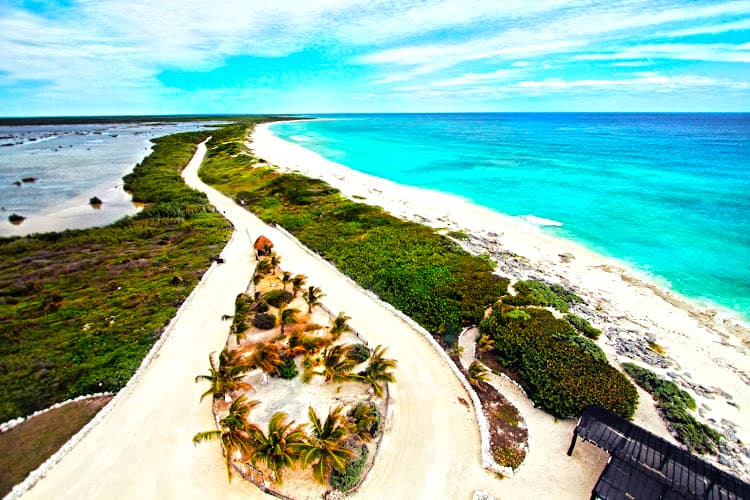
At the island's southern tip, inside Punta Sur park, sits a small Maya structure known as El Caracol — "the snail," named for its spiral form.
The interpretation frequently attached to it is striking: that the structure was built so that wind passing through openings fitted with shells produced an audible tone, functioning as an early warning of approaching storms. This interpretation is popularly repeated and should be held loosely rather than stated as settled fact — but the underlying premise is entirely reasonable. Maya coastal communities lived with hurricanes and had every reason to develop ways of anticipating them.
Punta Sur pairs this with the Celarain lighthouse, lagoons with crocodiles, and reef access, which makes it one of the few places on the island where cultural and natural interest genuinely overlap. If the weather is a factor in your planning, our guide to the best time to visit Cozumel is worth a look.
How to use this on the day
A few things that meaningfully improve a heritage-focused port day:
- Read the history before you arrive, not at the site. Reading a placard in direct sun with a group waiting is not how anyone absorbs information. Arrive already knowing the Ix Chel context and the 1518–1519 sequence.
- Ask your guide about Ix Chel and about the Caste War specifically. Good guides have far more depth than a standard script uses, and a specific question unlocks it. Vague questions get vague answers.
- Bring more water than seems necessary. San Gervasio is inland, humid and shaded only intermittently.
- Respect the living village. El Cedral is inhabited. Ask before photographing people.
- Do not try to do all four. San Gervasio plus one other is a realistic port day. Rushing all four guarantees that you understand none of them.
The advantage of booking an all-inclusive cultural experience cruise excursion in Cozumel is that transport, entry arrangements and guiding are handled as one package, so the day's cognitive budget goes toward what you are seeing rather than toward logistics — and, critically, so that your return to the ship is the operator's responsibility. You can browse the full range of Cozumel shore excursions and cultural tours or see what else there is to do on the island to build the rest of your day around it.
The bottom line
Cozumel does not hand its history to you. The structures are modest, the signage is limited, and the most significant facts about the island — that people crossed open sea to worship here, that a translator who reshaped the conquest was recruited here, that a village has commemorated its refugee founding every year since the 1840s — are entirely invisible unless someone tells you.
Now someone has. Bring it with you, and the stones stop being stones.
When you are ready to arrange the day, you can book a cultural excursion in Cozumel directly.