Every guide describes what Isla de la Pasión is. Almost none describe the journey — the road north past the hotel zone, the short boat ride across a shallow lagoon, and the geography that makes the water calmer here than anywhere else on Cozumel.
Getting to Isla de la Pasión: The Drive North, the Lagoon Crossing, and Why the Water Is Like That
There is a moment on the way to Isla de la Pasión when first-time visitors get quietly confused. You have been driving north along Cozumel's west coast — past San Miguel, past the hotel zone, past the point where the resorts thin out and the road gets emptier — and then the van turns inland, away from the sea you have been looking at for twenty minutes, and stops at a small dock on what is unmistakably not the ocean.
That is the correct place. And that inland turn is the single most important geographical fact about this island, because it explains everything people notice once they arrive: why the water is so shallow, why it is so calm, why it is warmer than the reef beaches, why there is nothing to snorkel, and why the wind on the rest of the island barely registers here.
Most Isla Pasión content describes the destination. This one describes the journey and the conditions — the drive, the crossing, the lagoon, and how the day changes with wind, tide and time of day. If you want the destination itself covered end to end, the complete guide to Isla Pasion Cozumel and the private island beach escape handles what is included, who it suits, and what to bring. This article picks up the part that guide moves through quickly.
The geography, in one paragraph
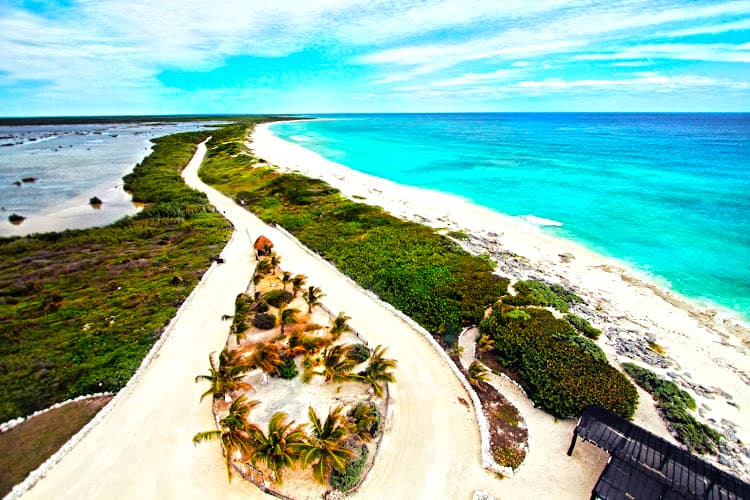
Isla de la Pasión is a small island tucked into a broad, shallow inlet near Cozumel's northern tip — a lagoon system separated from the open Caribbean by the island's own landmass. You do not reach it by crossing open water. You reach it by crossing a protected inner bay, and the crossing is short, flat and typically measured in minutes rather than any meaningful distance.
That protection is the whole story. On Cozumel's west side you get calm water because the island shelters you from the prevailing easterly wind. Inside the lagoon at Isla Pasión you get a second layer of shelter on top of that. It is, functionally, the most sheltered swimmable water on the island.
The drive north: what it actually looks like
From the cruise piers, the route runs north through San Miguel and continues up the coastal road. As a rough expectation, plan on somewhere in the region of twenty-five to forty minutes of driving depending on which pier you are docked at, traffic through town, and how many pickups your transfer makes. Confirm timing with your operator rather than treating any published figure as fixed — pier assignment alone can move it by ten minutes.
What you will notice along the way, in order: the waterfront malecón and downtown traffic, then the northern hotel zone, then a stretch where development thins considerably and the road narrows. The last portion feels distinctly less developed than the rest of the west coast, which surprises people who assumed a "private island" implies a manicured approach.
Two practical notes about this leg:
The road is the reason to leave a margin. Cozumel's coastal road is generally in good condition, but it is a single lane in each direction through the built-up stretch, and cruise-day traffic through San Miguel is real. Delays on this route are additive with every other decision in your day.
This is the opposite end of the island from the southern attractions. El Cielo, Palancar, Punta Sur and the southern reef beaches are all in the other direction. Combining Isla Pasión with a southern activity on the same port day means crossing the entire island twice, and that is usually more transit than a port day can absorb. If you are stacking activities, our Cozumel port day planning guide is the right place to sanity-check the timings before you book two things that fight each other.
The lagoon crossing
At the dock, you board a small boat for the transfer across to the island. This is not a sea crossing and should not be mentally filed as one.
The water you cross is shallow and enclosed. In most conditions the ride is flat — closer to a lake crossing than a boat trip. People prone to seasickness who have been dreading the water portion of the day are almost always relieved by it. People expecting a scenic ocean transfer are sometimes underwhelmed. Both reactions are common and both are just calibration.
A few things worth knowing before you step on:
- It is short. Whatever you need for the day should be with you, but you are not settling in for a voyage.
- Boats are small. This is not a catamaran with a bar. Expect a modest vessel and a straightforward ride.
- Shoes and bags get handled. Sandy dock, small boat, step up or down at each end. Anything you would hate to drop in shallow water should be in a closed bag.
- Mobility matters here more than at a beach club. The boarding step is the least accessible moment of the day. If anyone in your group has significant mobility limitations, ask about it specifically when booking rather than assuming.
Why the water looks and feels the way it does
This is the part visitors ask guides about most, and it has a clean geographical answer.
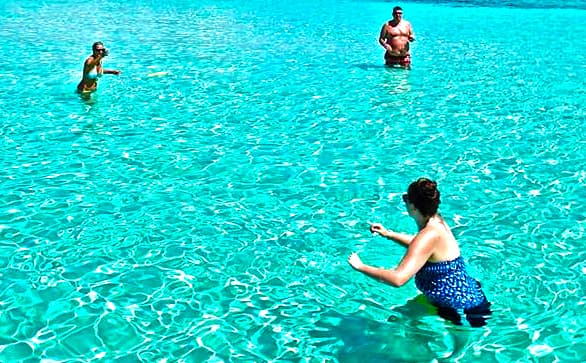
It is shallow. The lagoon and the flats around the island stay shallow well out from shore. In many spots you can walk out a considerable distance and still be at waist height or less. That is the defining feature — the reason it is so heavily recommended for families with small children, and the reason strong swimmers sometimes find it undramatic.
It is warm. Shallow, enclosed, sun-exposed water heats up more than deep reef water does. The temperature difference between here and a reef beach on the same day is noticeable, and it goes in the direction most people prefer.
It is calm. Double shelter — the island blocks the prevailing wind, and the lagoon blocks what is left. Waves are minimal in typical conditions.
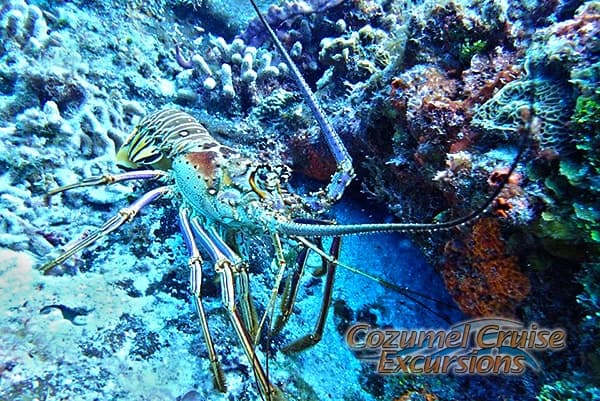
It is sandy, not reefy. And this is the trade-off nobody should discover on arrival: Isla Pasión is a beach destination, not a snorkeling destination. The bottom is sand. There is no reef structure to speak of. If snorkeling is what you came to Cozumel for, this is the wrong beach and you want the southern reefs instead — start from our full range of Cozumel excursions rather than trying to make this island be something it is not.
The colour changes through the day. Shallow sand-bottom water is highly sensitive to sun angle. Midday delivers the postcard turquoise. Early morning and later afternoon look flatter and greener. Photographers should plan accordingly.
Wind, tide and season: what actually changes the day
Because the water is so shallow, small changes have visible effects here that would be invisible at a deeper beach.
Wind. Cozumel's prevailing wind comes from the east. Isla Pasión sits sheltered from it, which is why it holds up on days when the island's east coast is unswimmable. If you have been told the sea is rough today, that almost always refers to the windward east side — it does not describe this lagoon. On unusual days with a strong northerly component, the shelter is less complete, but this remains among the most reliably calm spots on the island.
Tide. Cozumel's tidal range is modest, but on water this shallow a modest range is still noticeable. At lower water the walkable shallows extend further out and the swimming becomes more wading; at higher water there is more actual swimming close in. Neither is a problem. It simply means two visitors on different days can describe the same beach quite differently, and both are telling the truth.
Seaweed and season. Like everywhere in the Caribbean, seasonal seaweed can appear, and sheltered water can hold what arrives rather than flushing it out. Conditions vary year to year and week to week. Our best time to visit Cozumel guide covers seasonal patterns across the island in more detail.
Insects at the edges of the day. There is mangrove and low vegetation in this part of the island. Around dawn, dusk, and in still air after rain, biting insects are more of a factor here than on an open, breezy reef beach. Midday sun and any breeze keep them down. Pack repellent — reef-safe, ideally — and you will likely never think about it again.
Timing your day
The general shape that works: go earlier rather than later. Earlier means better light building toward midday, cooler transit, and a buffer against the traffic and transfer variables that stack up on the way back.
Build the return leg deliberately. Your day contains a boat crossing, a road transfer, and downtown traffic — three independent things that can each run long. Whatever all-aboard time you are working to, work backward from it generously. Nobody has ever regretted being back at the pier early.
If you are weighing this against other beach-day options rather than deciding logistics, the Isla de la Pasión and Passion Island beach overview sets out the comparison, and the Isla Pasion beach day excursion page covers what a booked day actually includes.
Who the journey suits — and who it does not
It suits you if: you have young children, you want genuinely calm and warm water, you are happy with a beach day as the day, and you would rather have a short flat boat ride than a long open-water one.
It suits you less if: snorkeling is your priority, you want deep water for real swimming, you are trying to combine it with a southern-island activity on a short port day, or you have mobility limitations that make a small-boat boarding step difficult.
There is no wrong answer, only a mismatch worth avoiding. Most disappointment at Isla de la Pasión traces back to someone expecting a reef and arriving at a sandbar, or expecting a five-minute hop and encountering a cross-island drive.
Frequently asked questions
Is Isla de la Pasión reachable by road? No. The road takes you to the mainland-side dock; the island itself requires the short boat transfer across the lagoon.
How rough is the boat ride? In typical conditions, not rough at all. It is protected inner water, and the crossing is brief.
Can you snorkel at Isla Pasión? It is not a snorkeling destination. The bottom is sand, and there is no reef structure. Cozumel's snorkeling is on the southern and western reefs.
Is the water deep enough to swim? Close in it is often shallow enough to stand or wade over a long distance. This is a feature for families and a limitation for anyone wanting deep water.
Which end of the island is it on? The northern end — the opposite direction from El Cielo, Palancar and Punta Sur.
How far is it from the cruise piers? Roughly twenty-five to forty minutes by road depending on pier and traffic, plus the short crossing. Confirm specifics with your operator.
Bringing it together
Isla de la Pasión makes complete sense the moment you understand where it sits. The inland turn, the lagoon, the shallow warm water, the absence of reef, the shelter from the wind — these are not separate quirks. They are one piece of geography expressing itself in five different ways.
Know that before you go and the day delivers exactly what it is built to deliver. For everything about the destination itself, read the complete Isla Pasion Cozumel private island beach guide, and when you are ready to lock in a date, you can book your Cozumel excursion here.